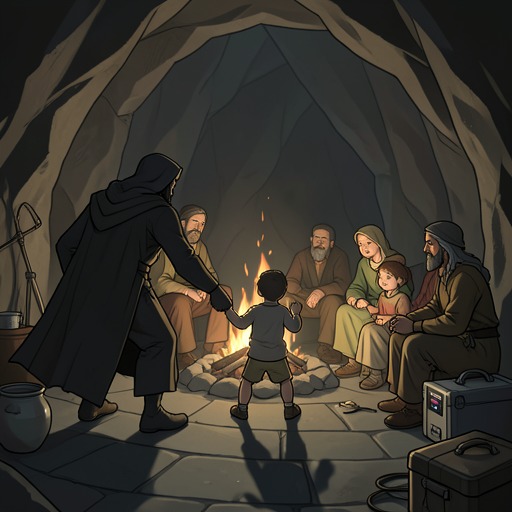
The Knudsen house burns down
The ChangelingThe Knudsen house burns down as Emma Valentine and Apollo Kagwa turn Jorgen Knudsen’s home from the setting of its concealed history into a deliberate fire trap. Emma’s response to the children’s portraits is immediate: she calls the place evil, tips three glowing space heaters onto the carpet, and hopes the resulting fire will destroy it. Yet the arson does not end with their escape. While smoke gathers above them, they force open a hidden basement door and find Kinder Garten at work, extending the house’s record of violence into a system of surveillance.
The house and the decision to burn it
Apollo begins by pointing out a small ink rendering of Agnes Knudsdatter, whom he identifies as the first child. He does not know the names of most of the other children pictured, but recognizes that Kinder Garten’s daughter, also named Agnes, must be among them. Emma moves closer to the wall, scans the faces, and picks up two fallen frames to hang them back in place. Then she lets her hands drop. Her quiet judgment, “This is an evil home,” follows the sight of the children and the mothers implicated by the images.
Emma turns all three space heaters back on. When their coils glow orange, she tips them facedown on the shag carpeting. Apollo recognizes that the act will start a fire; Emma answers, “I hope so.” Their decision is not an accident or a sudden escape from danger. They proceed through the first floor with the intention of making the fire spread, while taking care to limit its immediate reach beyond the property. Jorgen’s house stands alone on its lot, with driveways separating it from the neighboring houses. That space, they hope, will keep the blaze from spreading before firefighters arrive.
Making the fire spread—and containing it
The pair shut the windows and use months or years of newspapers and circulars from the dining-room table as kindling. They crowd paper around the heaters and place more in two rooms, preparing the interior to catch. The closed windows and circulars slipped beneath the front door help turn the building into a smoke box. The den has no windows, so a neighbor looking in would not see the flames there until they had spread. Their plan depends on concealment as much as ignition: from the street, the house still looks ordinary while smoke thickens inside.
As the carpet begins to singe and the first traces of smoke appear in the den, the suitcase is nearly empty. Apollo takes the mattock; Emma takes Brian’s outfit. They have changed into clothes taken from the house: Emma wears Jorgen’s oversized parka, its sleeves folded twice and its hem falling below her knees, while Apollo wears William’s clothes. In this brief transformation they become the Knudsens, leaving the ancestral home in its own garments as they set about destroying it.
Jorgen’s body remains pinned to a kitchen cabinet. Apollo first leaves the mattock and leans toward the body, but his attention is practical rather than sentimental: his fingerprints are on the knife handle, and he cannot know what might survive the fire. He braces a foot against Jorgen’s chest and pulls until the knife comes free, dislodging the body with a dull thud. Emma has already gone out the back. The act of arson therefore does not erase every trace of what happened inside; Apollo carries away the weapon that could connect him to Jorgen’s death.
The hidden room beneath the fire
Outside, Apollo and Emma walk alongside the house. The motion sensor bathes them in light, but Apollo does not flee or freeze as he had before. In daylight, the light would be barely noticeable from across the street or alley. They stop at a curious door without a handle or locks. Emma asks what Jorgen might have hidden in the basement if he kept pictures in the den. Apollo uses the adze end of the mattock to pry at the door. After three pulls, the wood lifts off its hinges and falls back.
The long staircase leads down beneath the heating floorboards. At the threshold, the pair hear faint tapping; then a man’s voice speaks of activating “subject twelve.” Apollo recognizes it. They descend as heat from the fire reaches the floorboards above. The basement contains a boiler, laundry machines, old paint cans, an air mattress, a thin pillow, and garbage bags of clothes. Among these domestic necessities is a computer system exactly like the one Patrice Green built in his basement apartment, with an iPad beside a monitor showing an infant cradled in a man’s hands. The ordinary household storage conceals a working surveillance station.
Kinder Garten is seated at the computer, wearing giant headphones, with blood droplets on the floor beneath his chair. Speaking as William, he identifies the place being watched as a house in Charleston, South Carolina, and refuses to give its address, saying that only paid subscribers receive platinum access. Apollo and Emma watch in choked silence as a father, two grandparents, and two teenage girls move through a large kitchen preparing breakfast. The basement reveal changes the meaning of the fire: the house is not only an evil home marked by portraits of lost children, but also the base from which Kinder Garten intrudes into another family’s private life.
Consequence and significance
The fire is meant to destroy Jorgen’s home, and its smoke is already accumulating while Apollo and Emma uncover the room below it. The juxtaposition makes the house’s two concealed histories visible at once: the wall upstairs records children and mothers, while the basement turns unseen families into monitored subjects. Emma’s hope that the building will burn and Apollo’s effort to remove the knife are both acts shaped by what the house contains, but the basement discovery interrupts their departure and exposes a further danger. The burning is thus both an attempted ending and a revelation: even as the pair set the home’s destruction in motion, they find Kinder Garten still operating inside it.